I have played a lot of videogames. However many you think I've played, I've probably played more. My personal collection of retro games spans about 1,500 titles. You know I'm rather thoughtful when it comes to all of them, but I wouldn't say I have any great insights into anything. I very much enjoy all the legends, like Chrono Trigger, Final Fantasy, Sonic, etc.
The games that I think about the most these days though are those that are rather rough around the edges and all but forgotten. Those games that had a niche appeal at best, and ultimately have stayed under the wire.
I'd like to talk about a few of my favorites across the three big systems of my youth.

You ever see One Crazy Summer (1986)? It's sort of a quintessential 80s friendgroup movie, featuring a large cast of quirky characters in a simple Save Our Home plot with some kind of boat race. It's a simple little world that's not terribly amazing but feels a little bit like it's at home in itself.
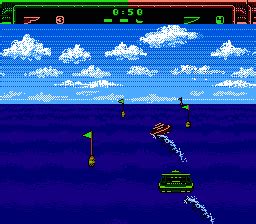
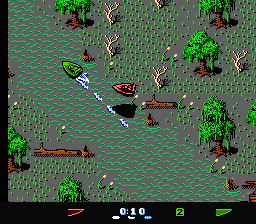
That's what Eliminator Boat Duel is. Released in 1991 for the NES, it brings you into the world of competitive motorboat racing.
I discovered this game in the summer of 2011 and it appeals to a very specific part of me. It's not my usual fare for a game in both gameplay and aesthetic, but it had me hooked all the same.
What's interesting about this game is that it features multiple different modes of play. There is a top down view where you're navigating your boat through a maze of obstacles somewhat reminiscent of a shooter. Then there is the 3rd person rear view where you take your boat in a head to head challenge with your competitor while avoiding buoys. In both of these, knowing when to use your nitro is key. Beyond that, there is the occasional side person view, which is mostly a test of timing, waiting for the bikini babe to wave her flag and then hitting your throttle.
Each level is made up of sections where the gameplay switches from one mode to the next, and how far ahead or behind in one section determines how ahead or behind you'll be in the next.
After each level, you take your prize money to upgrade and repair your boat. Hitting obstacles or the other boat repeatedly will cause damage and even undo your upgrades after a while.
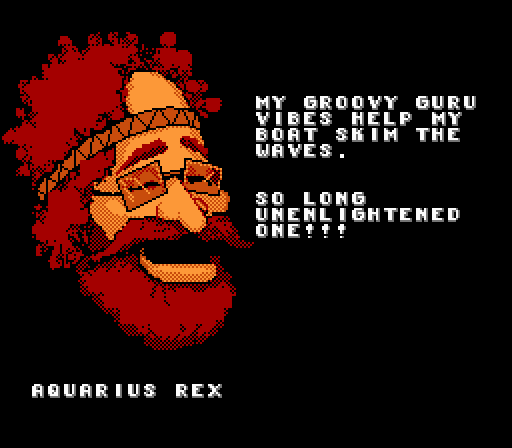
What really makes this game is its atmosphere. Like One Crazy Summer, it features a cast of quirky characters, all of them your rivals in the competitive motorboating scene and each level is pre-empted by your current opponent trash talking you.
Your opponents all feature a weird of sorts with some music to help identify their basic archetype. You have the good natured but kinda odd Weird Wally, the hippie dippy mentor type Aquarius Rex, the tsundere probably gay Vicious Vicky, the chill rival Surfer Bob, the anger management needing Mangler Mike, the charming leading lady Veronica Alabaster, and the mean spirited Disaster Don, the World Champion.
The game isn't complex or heavily involved, it is a standard run of the mill racing game that is solidly built, but in its simplicity you can find safety in this well defined world of quirky 80s characters taking their competition to unreasonable levels of seriousness. It is a comforting game for me, one that doesn't ask for much and provides a well laid out scenario that knows exactly what kind of vibe it provides.


I am not a big anime nerd much anymore, but there was a time of my life that I really enjoyed it. There are a few JRPGs that are very anime coded, not just in art style but how the game is organized, the one that comes to mind is Breath of Fire II (1994).
Lufia and the Fortress of Doom (1993) for the SNES is a very anime coded game, but generally gets overlooked compared to Lufia 2 (1995) which serves as a prequel. While Lufia 2 is superior to Lufia in many ways, having better graphics, smoother gameplay, and more involved dialog, Lufia holds a special place in my heart due to how much it dedicates itself to its cliches.
Lufia follows a band of heroes attempting to save the world from the return of these horrid demon kings, starring your typical anime protagonist and his not-girlfriend Lufia, a girl he grew up with in their home village. They're joined by the warrior Aguro and the half-elf Jerin the sorceress. I like games where you can see your entire party walking along all together, it makes it definitely feel more like you're a group on an adventure.
Throughout the game they travel around the world meeting a variety of characters and helping to solve their problems usually by fighting some monster. The characters include a scientist and his estranged son, a gluttonous king, and the surviving heroes of yore who defeated the demons once before. The plot is rather predictable, but it's a comforting trek through what feels like a typical adventure anime that doesn't try to be anything more ambitious.
The ending is surprisingly touching, with the climax having actually brought me to tears despite the pixelation and the fact that the rest of the game is mostly a series of silly romps. I am a sap though, and always a sucker for happy endings.
I originally played this in autumn of 2012 while I was waiting to start at OSU along with a bunch of other games that I'd heard of but never had a chance to check out. I remember it being so lighthearted which is something I needed badly while struggling with my anxiety at some of its worst in a time period when the fate of me and my family was up in the air.
I should play through it again sometime. It's considered rather crude compared to other JRPGs of the time, and Lufia 2 is considered a hidden gem among other SNES connoisseurs, but to me its simplicity is its charm.

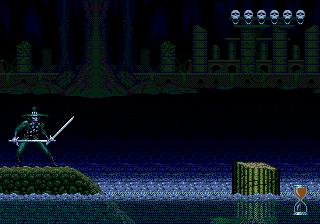
In 1992 or so, my brother lived in a condominium that was actually really close to the beach but I never noticed. His neighbor was an ex-army psychopath married to a traditional Korean woman with a daughter around my age that I would play with a lot. My Mom and her mom had talked a lot and we just kinda had the impression we'd get married someday. That obviously didn't happen, my brother moved out of that condo in 1997 or so, and her dad had gotten to the point he was wiretapping all his neighbors.
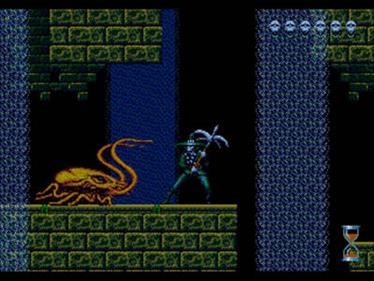
Regardless, as my brother moved out her dad gave me a videogame for the Sega Genesis he figured a boy would like. Chakan: The Forever Man (1992) was based on an obscure indie comic made by Robert Kraus of Akron, OH. It follows the brutal adventures of a swordsman who was so arrogant he challenged Death himself and won, being awarded a miserable immortality in return. He cannot die until all supernatural evil is killed, so he hunts horrid supernatural monsters.
This game is so cool. From the outset it has a dark and moody atmosphere illustrated through its psuedo-grunge soundtrack that the Genesis' soundchip lends itself really well to. The Genesis is generally compared unfavorably to the SNES in the music department, but I feel that the harsh tones of it matches perfectly many of the darker and edgier games that Sega managed to really succeed at marketing with.
However, the game is bad. The controls are sticky, unreactive, and the level design has a habit of testing your platforming skills with shoddy platform controls.
The level design leaves much to be desired. Every level is home to a legendary monster with a cool monologue to set the tone. However, many of the levels are just seemingly designed without the gameplay in mind. The American rental economy at the time necessitated that most games be as difficult as possible in order to minimize people being able to finish them over a weekend, and it shines through in games like this.
Beyond that, the first half of the game is much more polished than the second half. The first half features monsters that are well thought out and have a delightful amount of flavor, whereas the second half the game they seem to be fairly uninteresting and mostly unintelligent creatures.
The game is innovative in that it allows you to collect magic potions and combine them to produce effects like flaming swords. Your character is able to do acrobatics and if you master the sword system you can do all kinds of cool moves. But that is difficult, again because of the sticky controls. A lot of people seem confused by the ending boss, but I think it's obviously a hook for the sequel like the end of Blade (1998).
The game was originally going to get a sequel for the Saturn or the Dreamcast, and the developers had a lot of ambitious ideas for it, but ultimately they ended up making the game into Soul Reaver (1999), which is a fantastic game in its own right.
A few years ago around 2021 or so, I decided to collect the comics that inspired this game. The first of them was easy enough to find on eBay, but the second two were commanding ridiculous prices. I looked up Robert Kraus' website, which was still selling his comics and I sent him a few dollars and he sent me some of his leftovers. I was amazed he wasn't very far away, just over in Akron. I don't know if he still makes con appearances but I hope to run into him someday.
The comics themselves are interesting. The art quality can vary dramatically from page to page, and the later issues are more like illustrated novellas than comics. I like them a lot, and it has that 80s indie vibe that you can't fake.
Ultimately, the game is a fantastic example of darker and edgier done right, but executed poorly. It's a good memory.
If there's an organized fandom for any of these I haven't seen it. There are occasional pockets of people on YouTube or something that comment their memories now and again, but as far as I can tell I'm the only one out here singing some of these praises.
It's strange y'know? Once upon a time these games weren't that obscure, but nowadays people only remember the Final Fantasies and the Marios. Sometimes it feels like games like these are mine alone, and there's a certain satisfaction to that loneliness.
Still, I hope someone checks some of these out sometime, get a little taste of the past.