One morning in Autumn of 1995 I think, I got up to get ready for school, which was rather unfortunately typical for the time. Sometimes a friend of mine would stop by my house around then in order to get a ride to school, which my home was about halfway between. But actually he mostly came over to play on the Sega Channel.
I had first gotten the Sega Channel service in the Summer of 1995, and it was one of the coolest things in my life for a couple years that feel way longer than they actually were. It wasn't until I'd had it for a while that I started trying non platformer games. I didn't really understand RPGs, despite having played a few on the computer. My friend did a lot of exploring the Sega Channel menus outside my usual sections, and this morning he started up a game called Landstalker (1992) made by Climax.
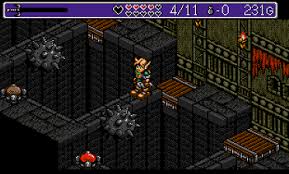
Now this is a pretty game. It's made by the same team of folks who are probably more well known for making Shining Force, and you can see the similarities in character design and music as well as the general art direction. You'll hear retrogame fans of this era call this a classic.
I hate this game.
To begin with, the biggest issue is that it is an early isometric platformer. So the movement direction is going to be moving along diagonal lines in relation to the screen. Not a big deal, most isometric platformers would just designate the direction pad buttons along the isometric axes. That is not what they did here, instead walking along those axes requires the pressing of the d-pad in the diagonal directions. Keep in mind the Sega Genesis controller doesn't actually have any diagonal inputs, the diagonal inputs are from two simultaneous direction presses. The result is an unreliable movement direction mechanic in a game that emphasizes careful platforming dexterity. Because of this, it tints the entire game with an air of frustration.
So this leads to its second largest issue which is rather comorbid with its biggest problem. The level design of the game has great emphasis on puzzle solving. You go through dungeons exploring them and trying to unlock doors and fighting monsters. It's pretty standard fare, except the monsters have a great deal of hit points, and because of this you'll be dodging around rooms and trying to corner them in order to take them down quickly. It makes combat extremely repetitive.
Combined with the wonky controls, having a precision isometric platformer that often involves pit jumps and careful timing becomes a slog. Some people swear the game is very easy, but for me this game feels like moving through mud.
Later isometric platformers added in some features to make things easier. One I can think of is Light Crusader (1995) made by Treasure, for the Genesis just a bit later. It too is an isometric platformer, but its emphasis is a bit more on combat than puzzle solving, but it does have elements of precise platforming. One of its strengths isn't simply better controls, which it does possess, but the addition of a shadow under the main character making it much easier to see where your character is jumping to.
Obviously lots of old games aren't that great. We have the extreme benefit of seeing how the video game industry has developed, while the original programmers were the ones who had to invent the foundation upon which our current giants sit. So why does this one bother me so?
I spent a lot of time on this game when I was younger. In the 90s it was very frustrating playing on my arcade stick. I tried again in the mid 2000s, with a keyboard for a while before I got a usb gamepad around 2008. I tried again in the mid 2010s while at OSU. I tried again around 2023 I think, completing most of the game in one drunken bender.
That last time is fascinating to me because I have zero memory of any of it, just a save file that puts me near the end of the game.
It's a really pretty game, it's professionally polished and has a lot of details worked in. The story is a bit plain, following a treasure hunter exploring towns and caves on some island somewhere. Because of the aforementioned issues with the controls and the puzzle design, the game feels like it lasts way longer than it actually does. Ultimately what I feel was intended to be a fun little adventure instead feels like a chore, and the payoff is ultimately fairly underwhelming with an ending that feels rather cut off. In some ways, the game is too neat- it doesn't invite itself to stay in your memory the way other games do through charming characters and epic stories.
Ultimately, it feels like a made for TV movie that drags an afternoon out, but in videogame form.
So I played through it slowly this past year, it ultimately only took me around 12 hours total to complete it on this go, and a lot of that was spent trying to do some of these puzzles while a little high and that definitely wasn't helping.
Landstalker isn't my ideal play experience, it drags out too much and the amount of time spent in dungeons solving tedious puzzles makes it feel like a lonely story, even if you are joined by a really jealous fairy.
I am glad I finally got through it. If only so I don't need to think about it ever again. There are certain games that meant a lot to me, and this is certainly one of them, but I think I'd like to relegate this to a cold California morning in the mid 90s and keep it there.