When I was a kid growing up in the 90s, the comic book industry was in a bit of a transitional period. Some people call it the Dark Age of Comic Books due to the industry's various shifts that were mostly of a darker fare. The 80s saw such classics as the Dark Knight Returns and Watchmen come into the scene, which spawned a gigantic shift toward the edgy.
Several other things were happening around the same time. One is that the Big Two were shifting towards having a more cohesive global continuity across their lines which of course went hand in hand with more direct editorial control. Jim Shooter at Marvel was infamous for *checks notes* making creatives submit their work on time. This earned him a reputation as a hard ass and he motivated many creatives to jump ship to DC as a result. I also suspect that this shift coincided with a productivity ramp up that goes hand in hand with the increased connectivity of the beginning of the digital age and the general increased energy demand of labor in late capitalist environment.
Perhaps related is that at the same time, the speculator market for comics exploded. Several classic comics got some significant media coverage for how much they went for at auction, such as Action Comics #1 and similar iconic issues that now go for ridiculous fortunes even in terrible condition.
The industry responded to this speculation by attempting to exploit it. Comics began to have "special" issues constantly, new #1 issues for new characters and relaunching old characters with new series, even ones that were already in progress. They would have special embossed covers, sometimes with wrap around artwork, and always always always emphasizing that this was the new BIG THING. It's sorta like exploiting fomo before we had the concept.
On top of that, big events would happen constantly, always trying to build up the feeling of "this is a classic unforgettable story that will be worth so much money someday." The most well known stunt of this caliber would be the Death of Superman in 1993, which is just what it sounds like. This was followed by the Reign of the Supermen in which four Superman substitutes appeared, a couple of which claimed to be the resurrection of Superman. Ultimately it was ended with the return of the real Superman. It all took place over about a year. The effects it's had on the industry as a whole are remarked upon by many experts and perhaps I'll ramble my two cents another day.
The entire industry followed suit. DC put out Bane breaking Batman's back and having to be replaced by some psychopath for a while. Green Lantern went nuts and killed everybody and a graphic artist had to replace him. Over on Marvel's side they put out things like the Spider-Man Clone Saga (which I haven't read myself, but it sounds like a fucking mess), and things like Thanos and the various Infinity Gem series. The Big Two were always emphasizing that things would *never* be the same again. Anyway, by the time the speculator bubble burst in the late 90s things had mostly returned to the status quo, as they would again and again.
But I want to talk about one of the biggest things to come out of the 90s comic industry, and that is Image Comics.
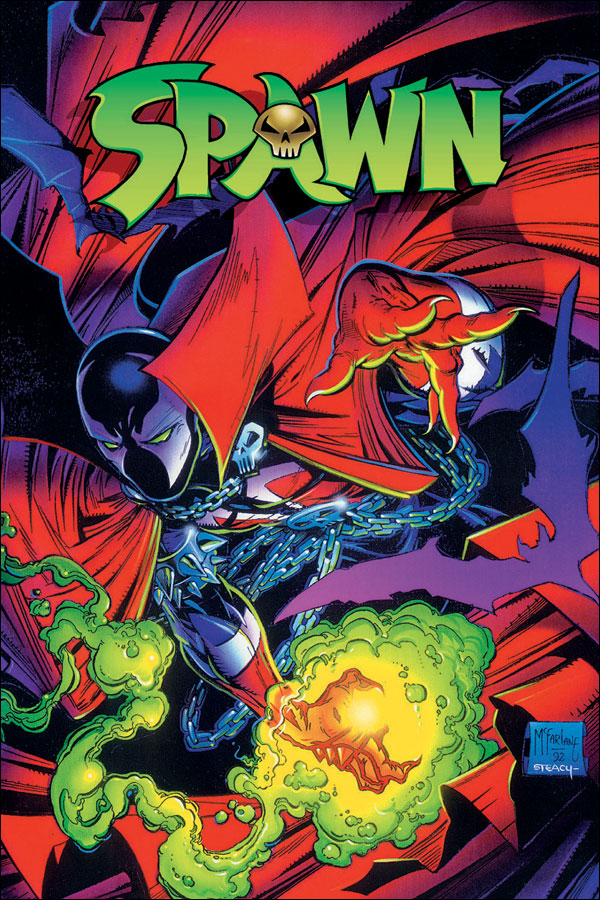
You may have heard of Image Comics' most famous features, like Spawn, or Witchblade, or the Savage Dragon. Image was formed by several disgruntled artists from both Marvel and DC, who were generally frustrated at the Big Two's policies concerning character creation ownership, which is to say that they didn't own anything they made for either one. So several of the big up and coming artists got together which included Todd MacFarlane (helped create Venom), Rob Liefeld (created Deadpool), Jim Lee (created Gambit), Marc Silvestri (worked on Wolverine), Jim Valentino (worked on Guardians of the Galaxy), Erik Larsen (worked on Carnage) and founded their own company in which they would each be co-owners and would thus own all their characters.
Early days of Image Comics touted this greatly, Spawn #10 (with guest writer Dave Sim) went as far as to depict artists who sold their creations to the Big Two as being condemned to hell and their creations similarly condemned trapped in cages, with the implication being that the "free" studio of Image was the morally correct future of comics. One or two issues later, guest writer Neil Gaiman created some characters in Spawn that Todd MacFarlane later claimed were his and that Gaiman had created them for him and thus he owned them, and it ended up in a long legal battle of a decade or more that resulted in Gaiman winning the rights to the characters. Some might say it's just the cycle of abuse, others say it's the nature of capitalism, others say that Todd MacFarlane was always a greedy hypocrite. Whatever the case may be, Image Comics established itself as a strong studio and seized a tremendous amount of marketshare in the 90s that led to a lot of follow-the-leader behavior from the Big Two.
Indeed, the greatest excesses of the 90s in comic books is embodied by Image Comics, who went all in on the darker and edgier content, and definitely hyped up their NEW BIG THING status on their covers.
When I was a kid, I mostly stuck to Superman, and got into comics with the Death of Superman storyline when I was around seven or eight. I did read the first Deadpool miniseries when I was around the same age, and I had a few Sonic the Hedgehog issues, but Superman was my personal hero.
Some kids at school were into Image comics though. One kid, who I remember nothing about at all, was really into Shadowhawk, who looked really cool. My brother really liked Spawn, who seemed really cool but it wasn't exactly appropriate for kids. They put out some cartoons of some Image series, like WildCATS and the Savage Dragon, that mostly matched the tone of the comics if severely watered down for children.
Ultimately, my exposure to Image comics was kind of limited despite them being everywhere at the time. When I was in my 20s I read a lot of contemporary Spawn, and was entertained by it. It's only recently though that I asked myself what the big deal was, how it is that Image was able to dominate the market for a while and put the Big Two on their toes (besides the poor senior management at both).
So I decided to pick up some old Image Comics series and take a look at what the big deal was. Occasional spoilers follow.
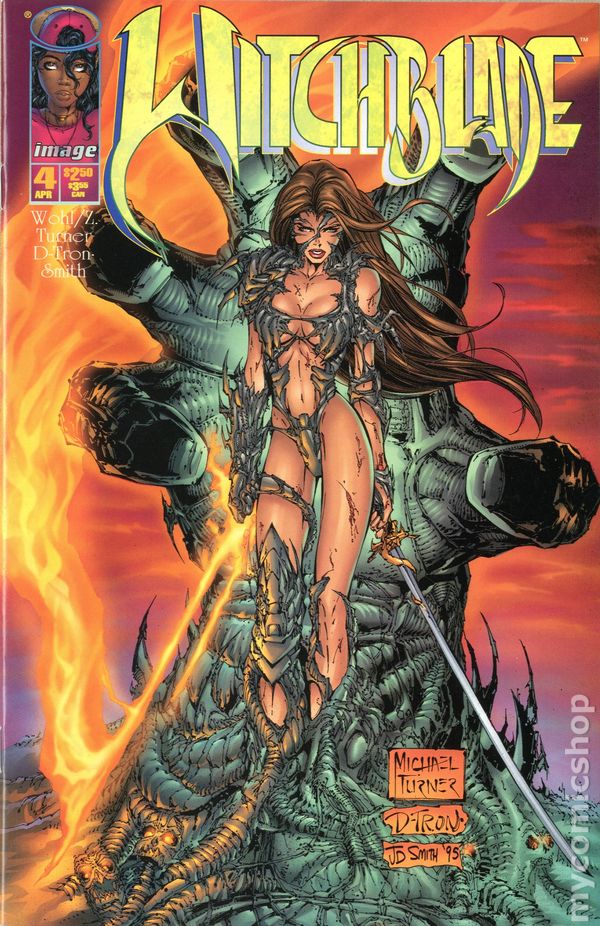
The first series I picked up is the oldschool Witchblade (1995) created by Marc Silvestri under the Top Cow label, which I admit to checking out first 'cause I'm kind of a horndog.
The series follows police detective Sara Pezzini, a NYPD officer who plays by her own rules, and she becomes the host of the Witchblade, a sorta magical biomechanical suit that appears and rips off her clothes at random times and gives her all sorts of vague powers like blades and lasers and strength and agility and whatever else the script calls for.
That's perhaps unfair, the same accusation has been leveled at Superman, especially in the Silver Age, but Witchblade's early issues seemed to be all style and no substance. The story was disjointed, and despite having a woman writer (Christina Z) it showed itself to be really misogynistic at times, including a point where Sara seems to debase herself by begging her rich abusive boyfriend's forgiveness for a small argument at an exclusive party, and the narrative seems to ignore this since it led into the first epic fight of the series, eight issues in. It perhaps was a poor choice for a first series to check out at Image due to the fact that it was one of their later series and seems absolutely designed just to grab horny guys' attention. Well I can't say it's a bad strategy.
I'm reading the reboot launched in 2024 now, and I have to say it is much more soberly put together, but lacks that edgy Liefeldesque 90s style that I concede has its charm.
I later checked out CyberForce, Silvestri's earlier Image series, which I had a much better time with, but I'll yammer about them another day.
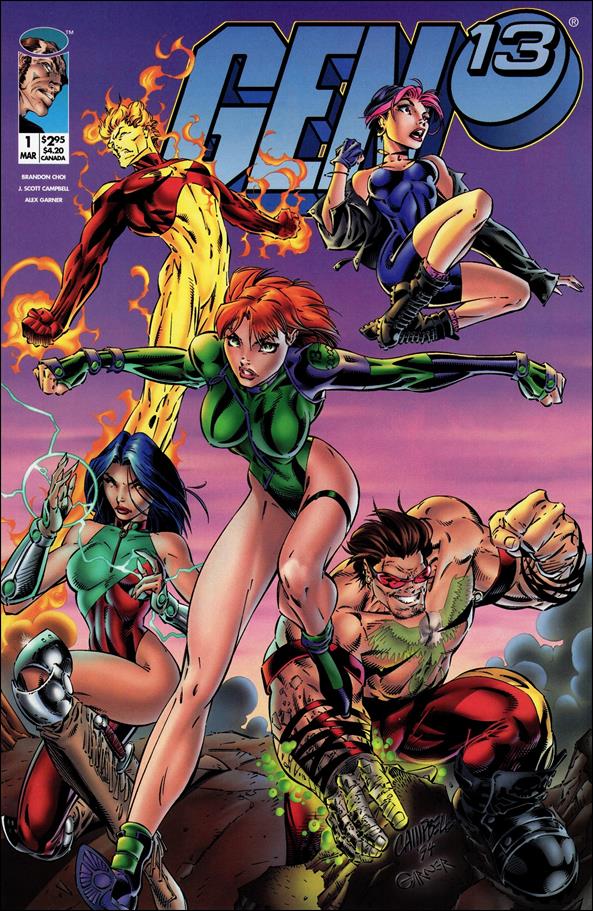
My next choice was Gen13 (1995) by Jim Lee under the WildStorm label.
Gen13 focuses on a group of college students who are all given superpowers by some evil corporation, who then follow the lead of a defector from the corporation who leads them in battles to stop the corporation from doing whatever it is it's trying to do.
First of all, I need to apologize to Witchblade for the implication that they were over-reliant on sex appeal, because as much as the series emphasizes hot chicks wearing very little, there is definitely a thoughtful plot in there. Over at Gen13, things are much more tongue-in-cheek.
The main hero, Caitlin Fairchild, is a super smart computer science major who has been given the body of an amazon warrior, and is very much framed as an innocent fanservice girl who says things like "why does it seem like my clothes are always getting ripped off?" Another is Sarah Rainmaker, a "Native American" (don't ask what tribe) who also is a "lesbian" (she never hooks up with any women, actually she gets together with two separate guys) and likes to walk around nude. They're joined by Grunge (yeah that's his name), who is horny for every woman around him and commits several acts that we would have called sexual harassment back then.
The plots are fairly stupid, featuring things like savage Amazon warriors making Grunge their loveslave and the other half of the team befriending some bloodthirsty pirates who nonetheless are depicted as being slightly better than the Amazons. Ultimately I couldn't keep reading because the writing seemed sloppy with any overarching plot feeling like an afterthought, though I heard it gets better.
I learned that Jim Lee later sold WildStorm (and with it Gen13) to DC and leveraged that to become one of their senior folks, leaving Image behind in the 2000s.
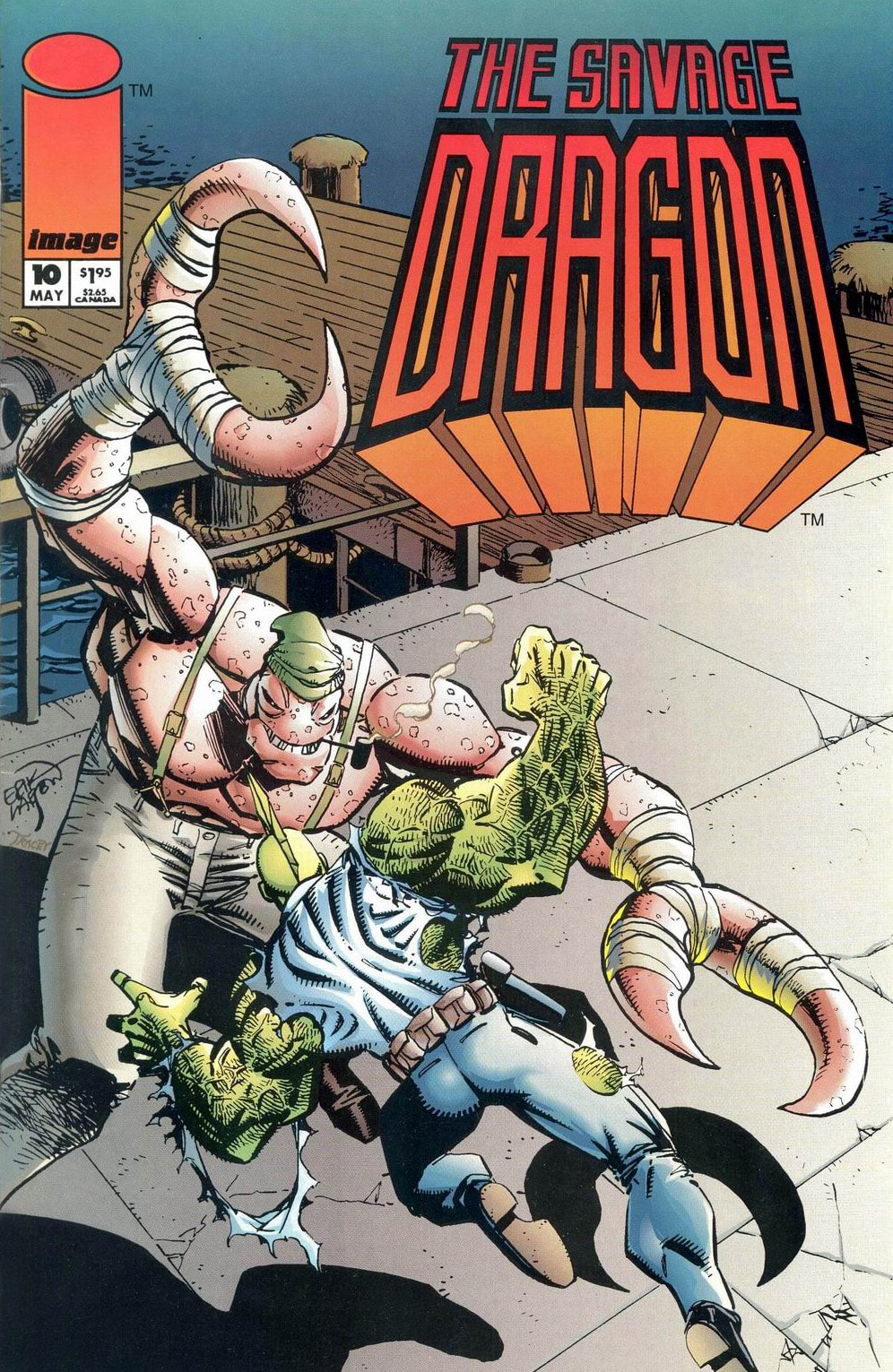
Next up was the Savage Dragon (1992) by Erik Larsen.
This one seemed stupid as hell and I didn't have high hopes for it after the fare of the previous series. Oh how wrong I was.
The series follows Dragon, a mutant (called freaks here, how nice) who was found amnesiac in a burning field and has now become a Chicago police officer, whose incredible brute strength is his main tool against the various superpowered freaks that have turned Chicago into a warzone.
So the first thing to note about this is that the comic endeavors to follow real time. There are many arcs that take place across the same few days across several issues, but then there will be a corresponding timeskip, with the assumption that the characters' lives are pretty boring in the meantime. I find this incredibly refreshing, and I wish more series would do this.
The writing is campy, with Dragon being a snarker during his fights with his many opponents, but also focuses on the personal lives of the characters and their intersectionality with the weirdness of their universe. Because of the real time aspect of the series, characters age, many die, others get older. From what I understand, the series has been about Dragon's son (born in issue #33) for the last one hundred issues or so (they are currently on issue 270something!).
I found myself following along, and the series definitely didn't lean so hard on the sex appeal (though still featured many shapely women in impractical outfits) and did seem to treat them as human beings (despite fridging a few of them, as was the custom at the time I guess).
I only read up until about issue #50, which is a whole lot really because it enticed me that much, but didn't want to burn myself out. I might continue someday.
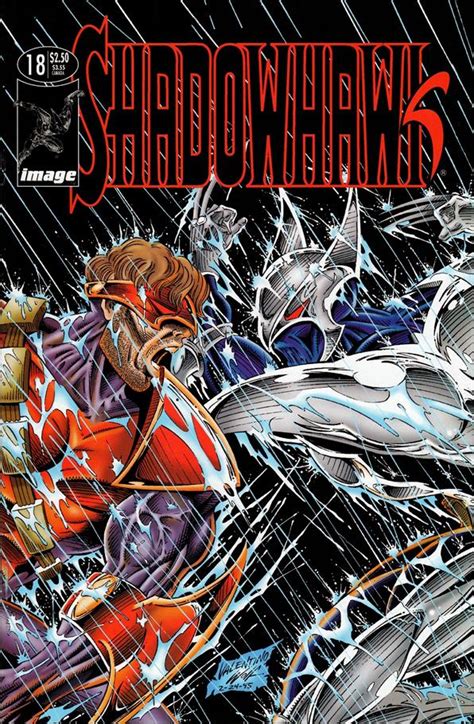
After the Savage Dragon, I finally decided to check out ShadowHawk (1992) by Jim Valentino.
At first, this pissed me off. It's a grim and gritty city full of horrid criminals who kill and rape with abandon, and the Shadowhawk is a vigilante who snaps their spines and leaves them crippled as a way to tip the scales of justice.
The creator made him to be sort of like Batman but without some of the things he saw as problems with Batman. Firstly, he found that Batman working closely with the Gotham Police and Commissioner Gordon was something that shouldn't work, as a vigilante, he's working directly against the police and their monopoly of force. Secondly, Batman leaves his villains alive, no matter what awful thing they've done or will do, and it has been shown they come back again and again (most famously in the Killing Joke by Alan Moore).
So the first issues do not reveal the identity of ShadowHawk, he does flips and tumbles off buildings, he wears some bulletproof armor, he fights brutally with blades in hand to hand, and he is absolutely unapologetic about his brutality. It gave me Death Wish vibes, which leaves a sour taste in my mouth. Definitely left me a little horrified that I learned about this series from a nine year old back in the day.
Then the series does something interesting. First, the second issue states that the ShadowHawk's victims are putting a tremendous strain on the hospital system by being made paraplegic. Then character spawns a copycat, Hawk's Shadow (yeah that's what they went for). Hawk's Shadow is also a brutal vigilante, but he kills his opponents, and specifically targets minorities, especially blacks. ShadowHawk confronts this jackass and reveals himself to be a black man, and a former district attorney. He beats the shit out of the racist prick.
ShadowHawk is also revealed to be HIV positive, and is living on borrowed time before he succumbs to AIDS. Ultimately, he does succumb to the disease, and the narrative also never really endorses nor condemns his actions morally. It leaves it to the reader to decide, but not in a way I find to be a copout.
I would say that this is probably the most interesting of the series I checked out from Image, and perhaps the most thoughtful on its social commentary. I would say it still holds up as a nuanced take on vigilantism and the psychological motivations behind it.
So ultimately while reading these series something finally clicked for me. The series were all very gritty, emphasizing violence and sexuality. As indie comics, they were not subject to the Comics Code Authority that ruled DC and Marvel (and Archie) at the time. The editing was often sloppy with strange script artifacts left in print. Sometimes I could spot a minor continuity error here and there. The writing was often all over the place. From what I understand, schedule slips were not just common but the norm. But the art quality was absolutely top notch all the way through.
Admittedly, my experience with indie comics is limited. I have a small collection of various indie series from outside the Big Two from the 80s, but mostly the original Teenage Mutant Ninja Turtles. Something I notice about a lot of those series is how dark they are, being free of the CCA, but the art quality ranges from alright to mediocre, sometimes from page to page.
The early Image Comics felt like an amateur project, unpolished and yet with masterful art by established industry professionals. The storylines were not the sort you'd find in DC and Marvel at the time, ranging from mature and thoughtful to kinda sleazy and half-baked.
It really felt like the forefront of a new movement. And in many ways it was, even though the CCA had already taken several blows to their authority through things like the reprinting of the anti-racist story Judgment Day from EC Comics in 1956, alongside Stan Lee's Spider-Man #96-98 in 1971 which negatively depicted drug use but was still rejected by the CCA and thus published without it, and then in the 80s DC launched their CCA-free Vertigo line after the success of things like Watchmen. But Image Comics was something that had a great deal of mainstream success among all the target demographics, and it would not be long before both DC and Marvel abandoned the CCA in favor of their own in-house rating systems.
So it strikes me now, reading these comics from this era that Image really did earn their reputation as a trendsetter, something that brought a more indie feel to the mainstream and encouraged more creator-owned business. I've heard that the Big Two have softened their stances on ownership, but I do not know any details, not even enough to know if that's really true. Image in the meantime is a bit more typical than they used to be toward their lower level creatives, though are very fair to their partners.
I've also indulged a bit in Image's newer products, but I'll save that review for another day. Ultimately, I'll say that Image Comics definitely earned their stripes back in the 90s and I look forward to reading more of their stuff, both old and new.